Early Summer 2020 Newsletter
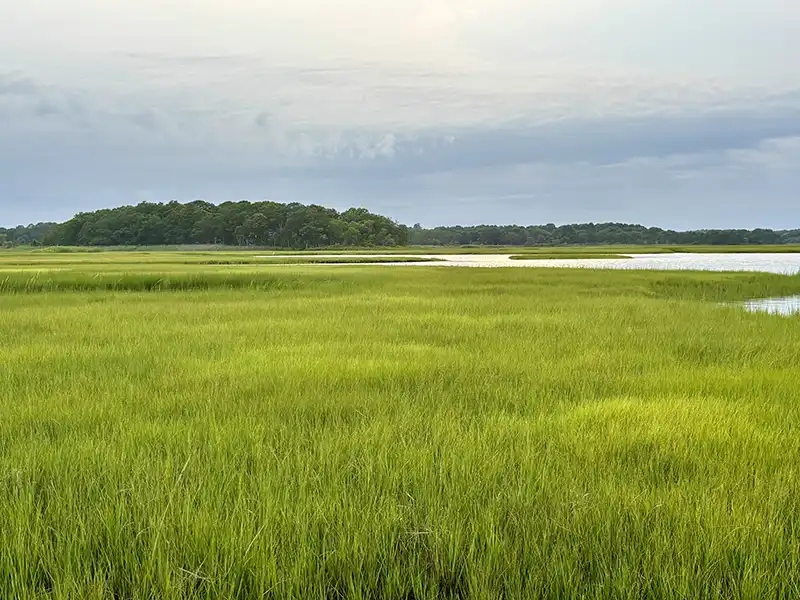
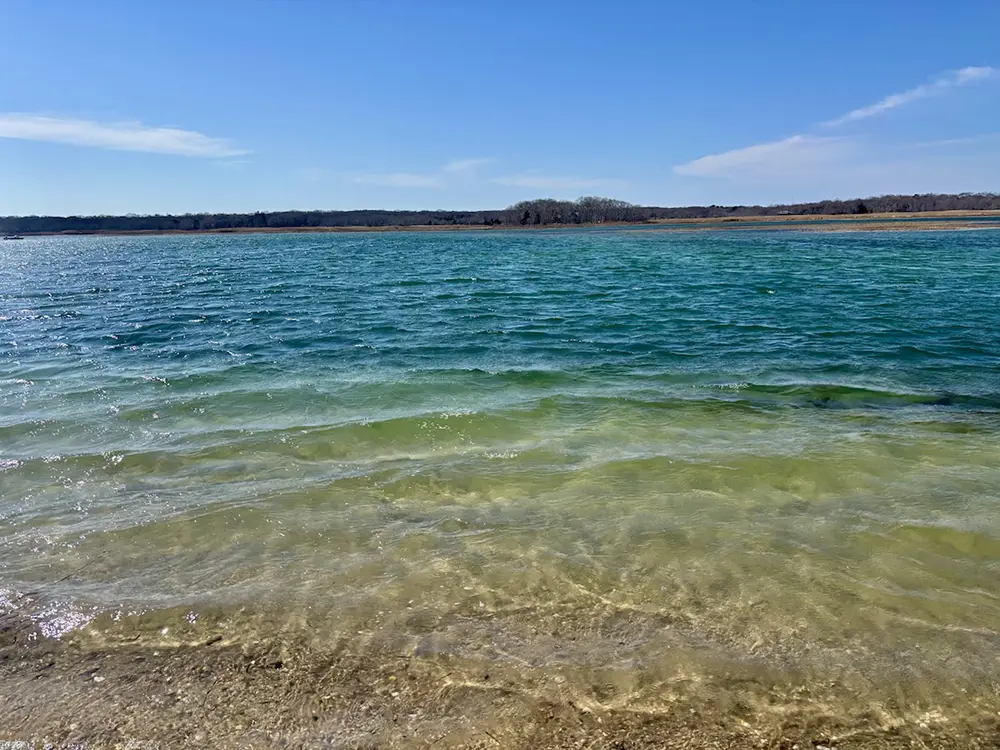
It’s really summer with the fish jumping in Accabonac Harbor, beach roses in full bloom, asclepias showing in the dunes and the billowy clouds in the sky..Although it is not advisable to meet face to face as we have in the past, the APC is working as hard as ever to protect Accabonac Harbor.
Yes, the summer is moving at warp speed. Be sure you visit Marders video cam. It is a bird’s eye view of an osprey nest in Accabonac Harbor with an incredibly beautiful view of Accabonac Harbor. You will be amazed at how the little ones have grown! It is on the APC website.
Later this month, we are co-sponsoring a tour of Marders pollinator garden hosted by Mica Marder with guest Tamson Yeh, entomologist at Cornell Cooperative extension. I am sure you remember Tamson from last year’s forum topic of mosquitos! Should be educational and fun.
Turtles
Turtles are on the move. I just helped this turtle cross Old Stone Hwy. He thanked me by posing for a picture. You may have noticed Turtle Crossing signs posted by APC. They are posted at locations where we have seen box turtles and Northern Diamondback Terrapin have been observed crossing. Thanks to your dues and donations, we were able to purchase the signs.
Diamondback Terrapins
The Peconic Estuary Program’s June Citizen’s Advisory Committee, co-hosted with Seatuck Environmental Association and Dr. Russell Burke of the Jamaica Bay a discussion of the Terrapin Project. It is an excellent video about these terrapins. https://vimeo.com/426392158
Fondly called the Terrapin with the clown lips, they often find themselves in harms way from cars and planes when they travel from the brackish waters they live in to a sandy spot to lay a clutch of eggs. Their swimming to shore is often impeded by a hardened shoreline. They can’t make it over bulkheads or stone walls.
I recently observed a female at Louse Point. She was crossing the road from the dune to the Harbor, maybe having deposited a clutch of eggs. Luckily, she had a few humans keeping watch as she safely made her way back to the Harbor.
Here she is coming out of the dune:
Later, having crossed, she disappears into the harbor:
Diamondback Terrapins have been known to go after bait in crab pots, get into the pot and can’t escape the pot and drown. There are devices known as Turtle Excluder Devices (TED) which prohibit the Terrapin from entering the trap. The Town Trustees will provide the Turtle Excluder Devices for no charge. If you have a crab pot, please inform the Office of the Trustees Their phone is 631-267-8688. The Trustee office is not open but they will leave the TED’s outside for you.
Also, Seatuck has a survey where Citizen Scientists like you can record sighting of Diamondback Terrapins.
https://www.seatuck.org/index.php/terrapin-watch
Mosquito Larval Sampling
I just learned that Accabonac Harbor will be treated for mosquitos tomorrow. The notice states both Bti and methoprene will be used. I trust only the hot spots will be treated.
In spite of the COVID-19 challenges of 2020, Vector Control has continued to utilize samples collected by Citizen Scientists to test for larval mosquitos, Its great to see cooperation on this level; County, Town, Trustees, The Nature Conservancy and volunteers.
You may recall meeting Nicole Maher’s of The Nature Conservancy presentation at last year’s APC forum called Marsh Madness. Nicole is defining a minimally invasive marsh restoration program using data collected by the Citizen Scientists as well as drone imagery. Hopefully, we will get the chemical controls down to zero. Heartfelt thanks to everyone working to protect Accabonac from unnecessary chemical applications.
The Sky
Our first virtual meeting, William Taylor’s Tour of the Night Sky was quite informative. William, a Senior Educator and NASA Ambassador to the Hampton Observatory, showed us what to look for in the night sky and used a software program to show us how the constellations have changed over the centuries., and how few stars are seen in a dark sky compared to looking at a dark sky. It is a startling difference. The dark skies over Accabonac Harbor allow us to see the vast array of stars overhead. In fact, life needs periods of darkness and light. We know birds need dark skies, especially those who migrate at night. Seeing an owl backlit by the moon is a precious sight.Homeowners can make simple changes to keep Accabonac Harbor‘s skies dark including turning lights off when they’re not needed and installing international dark sky compliant fixtures. We look forward to hearing more from William as the summer progresses.
Water Quality
The Town Trustees commissioned a rstudy on Water Quality from Christopher Gobler, PhD, Stony Brook Univeristy School of Marine and Atmospheric Sciences in 2019. In the executive summary, Dr Gobler reports that in 2019 most East Hampton Town Trustee waters were of a high quality, although fecal coliform levels in excess of State standards were observed in Accabonac Harbor, Hog Creek, Northwest Creek and Three Mile Harbor. Most measurements of dissolved oxygen and chlorophyll were supportive of fisheries but seasonal deviations were observed at nearly all locations. Harmful algae concentrations were generally low, except for the harmful dinoflagellate Cochlodinium In Hogg Creek and Northwest Harbor. Microbial tracking of fecal bacteria found that in Accabonac Harbor, birds were the main source of bacteria in Pussy’s Pond and its tributaries. Dogs and small mammals were the source near Gerard Drive. Three Mile Harbor had a mix of dogs, small mammals, birds, humans at moderate levels.
The Trustees approved Dr. Gobler’s proposal to continue the research in 2020, including 3 sites in Accabonac Harbor. Microbial Source Tracking (MST) will be performed. Fecal coliforms analysed based on DEC numbers. Total nitrogen to be measured. Enterococcus to be measured as part of MST work. Cochlodinium to be measured. Three stations; at Louse Point ramp, Shipyard Lane and west side of harbor opposite culvert (at the end of a town owned trail).
Sniffing Dogs
APC is co-sponsoring a project using “Sniffer Dogs” trained to detect the presence of human fecal matter. The canines are from Environemntal Canine Services (ECS). ECS says the canines are a complimentary tool to traditional methods such as laboratory testing. The canines are said to be able to immediately distinguish human from animal water, can rapidly locate or isolate discharge source and are very cost effective. The Town has worked with this company in the past, a team collected samples last week from several sites in Accabonac Harbor, including Pussys Pond. It will be interesting to compare these findings with USGS and other more technical analyses.
Here are the samplers, Samantha Klein, Mellissa Winslow from the East Hampton Town Department of Natural Resources and Kate Rossi-Snook of the Concerned Citizens of Montauk. Kate manages the CCOM’s enterococcus bacteria testing program.
Will let you know when the results are available.
Conditional Shellfishing Update:
As you may recall, the Trustees informed us earlier this year about the conditional shellfishing in Accabonac Harbor. The conditional area closed for the season on April 30th. John Alldred reports that he didn’t get much feedback as to harvests in the area, but the feedback seemed to indicate that there were not a lot of clams found in the northern part of the harbor. The bayman he spoke with said the composition of the population was similar to what it had been before the area was closed to shellfishing, which was several years ago.
The Trustees had been testing for fecal coliforms with the DEC until that was discontinued due to the virus. It is not clear how that will affect the status of the area for next winter.
Birding
The following is a contribution from APC member Bruce Horwith. Bruce is a Conservation Biologist and a active birder who owns Wild Bird Crossing in Bridgehampton. APC Vice President Chris Ganitsch asked him to describe a day of birding around Accabonac Harbor.
If there is any silver lining to be found within the Covid craziness that is reshaping our lives, it may be the increased interest and awareness that many are feeling about the natural world that exists outside the doors that are sheltering them. I have been delighted by the countless stories that I have heard from people like Chris. Many of them – unlike Chris who is no stranger to the natural word – are newcomers. In some cases, literally new arrivals from the City and other urban settings; but far more are only newcomers in the sense that it is just within the past few months that they have more fully entered into the natural world that has been around them forever. And like many new converts, they get great pleasure, and in fact almost feel driven, to share their observations!
I invited my friend, fellow birder Chris Gangemi, to join me for a few hours to see what birds we could see – and hear – in and around Accabonac Harbor, with the idea that I would share this list with those of you reading this newsletter. Fortunately we were also joined by a new member to the East End birding community, Chris’ teen-age daughter Mia. I would like to say it was just beginner’s luck that she found some of the best birds of the day, but the reality is that she heard calls and songs that never made it past my ears and into my imagination. I hope the list sparks your curiosity, and even better, that it will inspire you to go out soon and see how you can do.
Species
American Crow
American Goldfinch
American Robin
Baltimore Oriole
Bank Swallow
Barn Swallow
Black-bellied Plover
Black-capped Chickadee
Blue Jay
Blue-gray Gnatcatcher
Brown-headed Cowbird
Carolina Wren
Chipping Sparrow
Common Grackle
Common Tern
Common Yellowthroat
Double-crested Cormorant
Downy Woodpecker
Eastern Bluebird
Eastern Kingbird
Eastern Screech-Owl
Eastern Towhee
European Starling
Fish Crow
Gray Catbird
Great Black-backed Gull
Great Blue Heron
Great Crested Flycatcher
Great Egret
Herring Gull
House Finch
House Sparrow
House Wren
Least Tern
Mallard
Mourning Dove
Mute Swan
Northern Cardinal
Northern Flicker
Northern Mockingbird
Osprey
Prairie Warbler
Purple Martin
Red-bellied Woodpecker
Red-tailed Hawk
Red-winged Blackbird
Ring-billed Gull
Ruby-throated Hummingbird
Ruddy Turnstone
Saltmarsh Sparrow
Snowy Egret
Song Sparrow
Tree Swallow
Tufted Titmouse
White-breasted Nuthatch
Willet
Willow Flycatcher
Yellow Warbler
Well said, Bill. Thank you!
That is all for now. As always, your dues and donations are appreciated. https://accabonac.org/contact-and-donate
Stay safe and enjoy nature all around us.
Sincerely,
Patrice Dalton, President
Accabonac Protection Committee
*Photos courtesy of Patrice Dalton