The Barbara Barnes Hale Nature Preserve
The Barbara Barnes Hale Nature Preserve is a 17-acre parcel on the west side of Accabonac Harbor, accessible from Springs-Fireplace Road near its intersection with Hog Creek Road. The Town of East Hampton and Suffolk County acquired the property in 2001, after some 15 years of lobbying by the APC and others, including The Nature Conservancy and what is now Group for the East End. The parcel was subsequently designated a town Nature Preserve, named at the request of the APC after Barbara Barnes Hale, a Springs naturalist and educator who died in 2003.
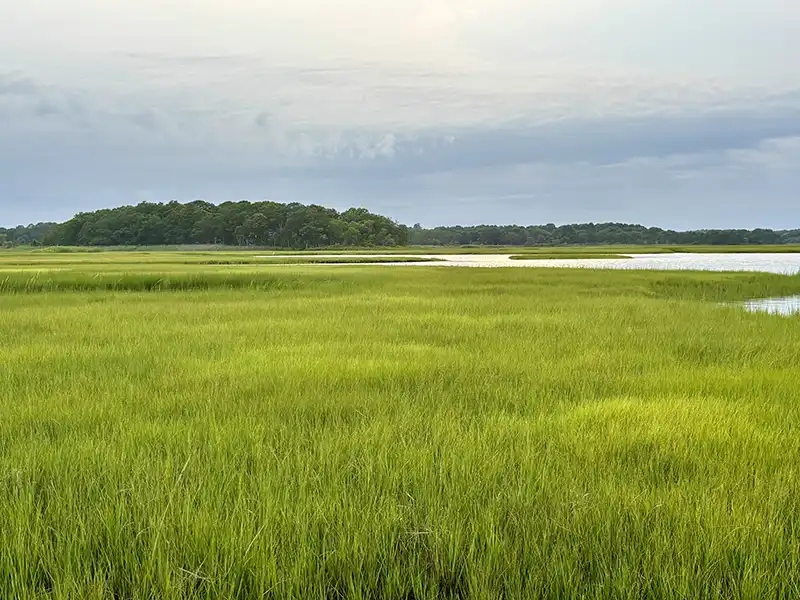
Like much of the environs of Accabonac Harbor, the Barbara Barnes Hale Preserve was traditionally maintained as a meadow by animal grazing and annual mowing with a sickle bar. At the time it was acquired by the county and town, however, many years had passed since cattle or horses grazed the land or the parcel had been cleared; it was on its way to becoming a forest, threatening not only a unique and historic vista of Accabonac (a Scenic Area of Statewide Significance) but also a habitat that has become increasingly rare. Once home to meadowlarks, killdeer, upland sandpipers, grasshopper sparrows, visiting glossy ibis, hunting kestrels, quail, pheasant and numerous other animal and plant species, the meadow gradually has been overwhelmed by shrubs and trees, many of them non-native.
APC persuaded the Town Board that restoration and maintenance as a meadow is the best use of the Barbara Barnes Hale Preserve. After extensive lobbying by us, the town’s Natural Resources Department obtained permits from the NYS Department of Environmental Conservation for limited clearing. APC continues to work with the Town to achieve a more comprehensive restoration of the meadow.
Chronology of Barbara Barnes Hale Nature Preserve
1956: Sheridan Lord purchased 21 acres from Tom Collins (rented to Syd Miller for dairy-cattle grazing). For the following 10 years, dairy, then beef cattle, then horses, plus annual sickle-bar, kept grass short
Late 1960s: 17.5 are acres sold to Dan Weitzman, for “2 houses for 2 sons.” Next, Weitzman applies for permit for 5 houses and a turn-around, Town asks for topographical survey
1985: APC forms to fight such development and other threats to health of Accabonac. Begins pressure on state, county & town to acquire the property
Ensuing years see advice to Weitzman from Jim Walker of Interscience not to mow lest NYS-DEC object. Result? Bushes grow up
1990-91: Weitzman seeks 4 lots, 3 requiring bridge or fill for access
1991: Town zoning changes reduce lot yield. While awaiting permits for ever-fewer houses, ending at one … Dan Weitzman dies. Heirs continue to seek permits. 17.5-acre piece remains at top priority for purchase by Town, but no funds located
2000-01: After Community Preservation Fund set up and in partnership with County, Town immediately buys Weitzman property
2003: Property becomes East Hampton Town Nature Preserve
2005: At APC’s request, with help from Councilperson Debra Foster, Town names it Barbara Barnes Hale Nature Preserve in memory of prominent local naturalist and educator
2005: EH Town passes Comprehensive Plan that includes “meadow restoration” for Barbara Barnes Hale Preserve
2006: Stone with plaque placed at entrance referring to the Barbara Barnes Hale Nature Preserve as “this meadow”.
2007: Accabonac is included as “Scenic Area of Statewide Significance” (i.e.: it’s officially important to be able to see it)
July 2007 After much urging from APC and Town Board, Larry Penny submits application to John Pavacic at DEC for permit
October 2007: DEC not convinced: sees deer, hears birds; requests more detailed plans, but only for trails
Feb 2009: Fred Thiele arranges meeting with Larry Penny, DEC reps Dawn McReynolds and James Gilmore, and APC. McReynolds agrees to consider revised application
April 2009: Proposal is revised for clearing in selected areas. Application is submitted April 22, 2010: DEC permit is granted
Spring 2011: Clearing finally gets underway, but Natural Resources Director Larry Penny allows a local landscaper to remove trees not included in permit. County outraged, DEC issues cease and desist
2012: After much pleading and promises, DEC and County are back on board, but Larry Penny has resigned. Kim Shaw becomes head of Natural Resources. The permitted clearing gets done in about 3 days…but is insufficient for meadow restoration. After meeting with DEC and Suffolk County, all agree to a revised plan. County agrees to do mowing. Hurricane Sandy aftermath causes delay of mowing. Once done, again, the area cleared is not sufficient to provide the full benefits of meadow restoration
October 2014: Accabonac Protection Committee adopts the Preserve through the Town’s Nature Preserve Committee. Currently, Kim Shaw and APC are seeking a new approach to bringing back the grassland and the species that once thrived there
Why So Concerned about a Meadow?
A great many people have always believed that the original condition of Long Island and of Springs, our local piece of it, was wooded; that the white man found forests when he arrived, and gradually cleared land for agriculture.
However, while doing research for our recent film, Grasslands, we discovered quite the contrary. In the nation as a whole, as well as L.I., the earlier the maps we found, the more grassy they looked. The grassy Midwestern plains, where the buffalo roamed, were matched by almost the whole of L.I. including the environs of Accabonac Creek. The earliest local map we have found, from 1838, shows the shores and surrounds of the creek in grass symbols, which are the same as those we use today. No distinction was made between marsh grass and upland grass, but islands and peninsulas that are today covered in dense woods are shown as grassy and probably never were wet enough to be marsh.
[photo]
More recent aerial views tell the
same story: the Fillipelli tract in the earliest picture was grass with scattered cedars, and more recently has become woods. Some Springs residents remember a Smith tract between the creek and Old Stone Highway, later owned by Ward Bennett and later still by Andy Sabin, that went through the same progression.
We have been told that the Indians who lived here traditionally burned these grasslands over, and that this would have served to improve the hunting. Once farming came, late in the 17th Century, Springs — because the soil was poor in general — was used for grazing rather than crops.
In 1956, what is now the Barbara Barnes Hale Nature Preserve was rented to a dairy farmer and grazed by Holsteins. Later, beef cattle were pastured there and, eventually, horses. Besides the grazing, the fields were maintained by an annual pass with a sickle-bar. In those days, the waters of the creek were crystal-clear and the bottom dotted with scallops and thick in places with eelgrass.